
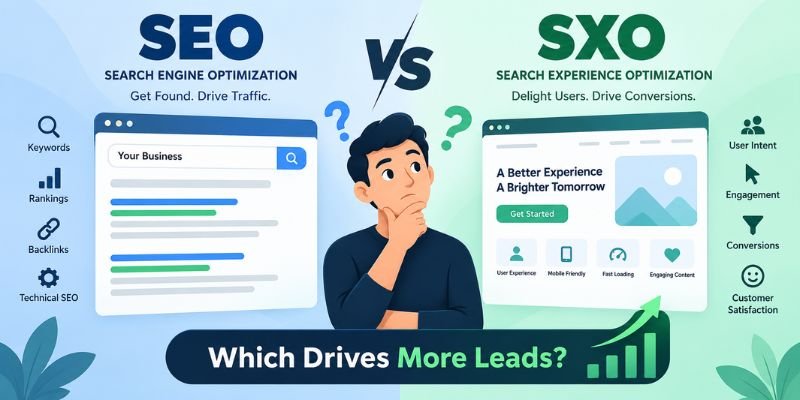
Getting your website to rank on Google feels like the finish line. But what happens after someone clicks?
A website can attract plenty of organic traffic and still generate very few enquiries. This is where the difference between SEO and SXO becomes important. SEO helps your website get discovered in search, while SXO looks more closely at what happens once a visitor arrives.
So, SEO vs SXO: which one matters more for generating leads? The answer is not about choosing one over the other. It is about understanding how both work together to turn search visibility into meaningful business results.
What Is SEO?

SEO, or Search Engine Optimisation, is the process of improving a website so that search engines can understand, discover and rank its pages for relevant searches.
A strong SEO strategy considers factors such as search intent, content relevance, technical performance, internal linking, website authority and page experience. The objective is to attract people who are genuinely looking for the products, services or information a business provides.
For example, if someone searches for “SEO agency for small businesses”, SEO helps a relevant service page become visible for that search.
However, ranking is only the first part of the journey. Getting someone to your website does not automatically mean they will contact you, request a quote or make a purchase.
What Is SXO?
SXO stands for Search Experience Optimisation. It combines search optimisation with the experience a user has after arriving on a website.
Instead of asking only, “Can people find this page?”, SXO also asks, “Does this page give visitors what they expected, build trust and make the next step easy?”
This means considering the connection between search intent, useful content, website usability, trust and conversion.
Imagine someone searching for “local SEO services”. They click a result expecting to understand what the service includes, whether the provider is credible and how they can get started. If the page is confusing, slow, difficult to navigate or lacks a clear next step, the business may lose that potential lead even though its SEO succeeded in attracting the visitor.
SEO vs SXO: What’s the Difference?
The simplest way to understand the difference between SEO and SXO is to look at where each one places its strongest emphasis.
| SEO | SXO |
| Focuses primarily on search visibility | Focuses on search visibility and the user experience |
| Helps attract relevant organic traffic | Helps make that traffic more useful and conversion-friendly |
| Optimises content, technical elements and authority | Connects search intent, content, usability and conversion |
| Asks whether users can find the website | Asks what happens after users find it |
| Supports organic growth | Connects organic visibility with business outcomes |
The two approaches are not competitors. In fact, effective SEO and SXO should complement each other.
SEO without a good experience can bring visitors to a page that fails to convert. SXO without strong search visibility may create a great experience that very few people discover.
SEO vs SXO: Which Drives More Leads?
If your main objective is lead generation, SXO can make a significant difference once SEO is already bringing relevant visitors to your website.
Consider a potential customer searching for “web design company in India”. SEO helps a relevant page appear for that query. But once the visitor arrives, several questions immediately matter.
Does the page answer their search clearly? Does it demonstrate expertise? Can they understand the service quickly? Is the website easy to use on mobile? Can they see evidence that the company is trustworthy? Is there a clear and natural way to enquire?
These are SXO considerations.
This is why asking whether SEO or SXO is “better” can be misleading. SEO creates the opportunity to be found, while SXO helps create an experience that can move a qualified visitor towards taking action.
How SEO and SXO Work Together
Think of the customer journey as a simple sequence: attract, satisfy, build trust, and convert.
SEO helps attract the right audience by matching content with relevant searches. Once visitors arrive, SXO ensures the page continues to meet the intent behind that search.
The content needs to answer the user’s question rather than simply repeat keywords. The website should be easy to navigate and understand. Trust signals should be visible where they matter, and the next action should feel natural rather than forced.
For businesses investing in SEO for lead generation, this connection is particularly important. More traffic is useful only when that traffic has a realistic opportunity to become a customer.
When Should a Business Focus on SXO?

SXO becomes particularly valuable when a website is already receiving organic traffic but is not generating enough enquiries from it.
You may have pages ranking for valuable keywords, yet visitors may leave without contacting you. Perhaps the content answers the search but does not explain the service clearly. Perhaps the call to action is difficult to find, the mobile experience is frustrating or the page does not provide enough information to establish trust.
In such cases, simply trying to increase rankings may not solve the underlying problem. Improving the search experience can help businesses get more value from the visibility they have already earned.
How to Build an SEO and SXO Strategy
A strong SEO and SXO strategy starts with understanding what your audience is actually searching for and why.
The content should then answer that intent clearly and demonstrate genuine expertise. Once the visitor lands on the page, the experience should be fast, readable, mobile-friendly and easy to navigate.
Trust also matters. Clear business information, relevant evidence, transparent communication and useful content can reduce uncertainty before a visitor decides to enquire.
The final step is conversion. A clear call to action should guide users towards the appropriate next step without interrupting their experience.
This is the approach that Site Invention can help businesses work towards: not simply attracting search traffic, but creating a website experience designed to turn relevant visitors into genuine opportunities.
From Search Visibility to Real Business Growth
Ranking on Google is valuable, but a ranking alone does not create a customer.
SEO helps your business become visible when potential customers are searching. SXO takes the next step by considering whether the experience actually satisfies their intent and encourages meaningful action.
For businesses that want SEO to contribute to enquiries rather than simply traffic numbers, combining SEO with a strong search experience is a much more complete approach. The real goal is not just to be found. It is to be found by the right people and give them a reason to stay, trust and take the next step.
FAQs
Q1. Is SXO better than SEO?
Answer: No. SXO is not a replacement for SEO. SEO focuses strongly on search visibility, while SXO extends that thinking into the experience users have after arriving on the website. Using both together creates a stronger path from search to conversion.
Q2. Does SXO improve SEO?
Answer: SXO can support a website’s overall search performance by encouraging businesses to create useful, relevant and user-focused experiences. However, SXO should not be treated as a shortcut to higher rankings.
Q3. What is the difference between SEO and SXO?
Answer: SEO primarily helps the right audience discover a website through search. SXO considers both discovery and what happens after the visitor arrives, including relevance, usability, trust and conversion.
Q4. Can SXO increase leads?
Answer: SXO can help increase leads by reducing friction between arriving on a website and taking action. Its impact is particularly valuable when a website already attracts relevant organic traffic but struggles to convert visitors.
Q5. Should businesses use SEO and SXO together?
Answer: Yes. SEO can bring qualified visitors to a website, while SXO helps ensure those visitors find a useful, trustworthy and conversion-friendly experience.
