
Have you ever wondered how ChatGPT can recommend a website you have never mentioned?
You ask a question such as Which SEO agency can help improve my website? and ChatGPT may return an answer containing links to relevant websites. But where did those websites come from? Does ChatGPT crawl the internet like Google? Does it use Google’s index? And what makes one website more likely to be cited than another?
Understanding how ChatGPT finds websites is becoming increasingly important for businesses that want to remain visible as search moves beyond traditional Google results.
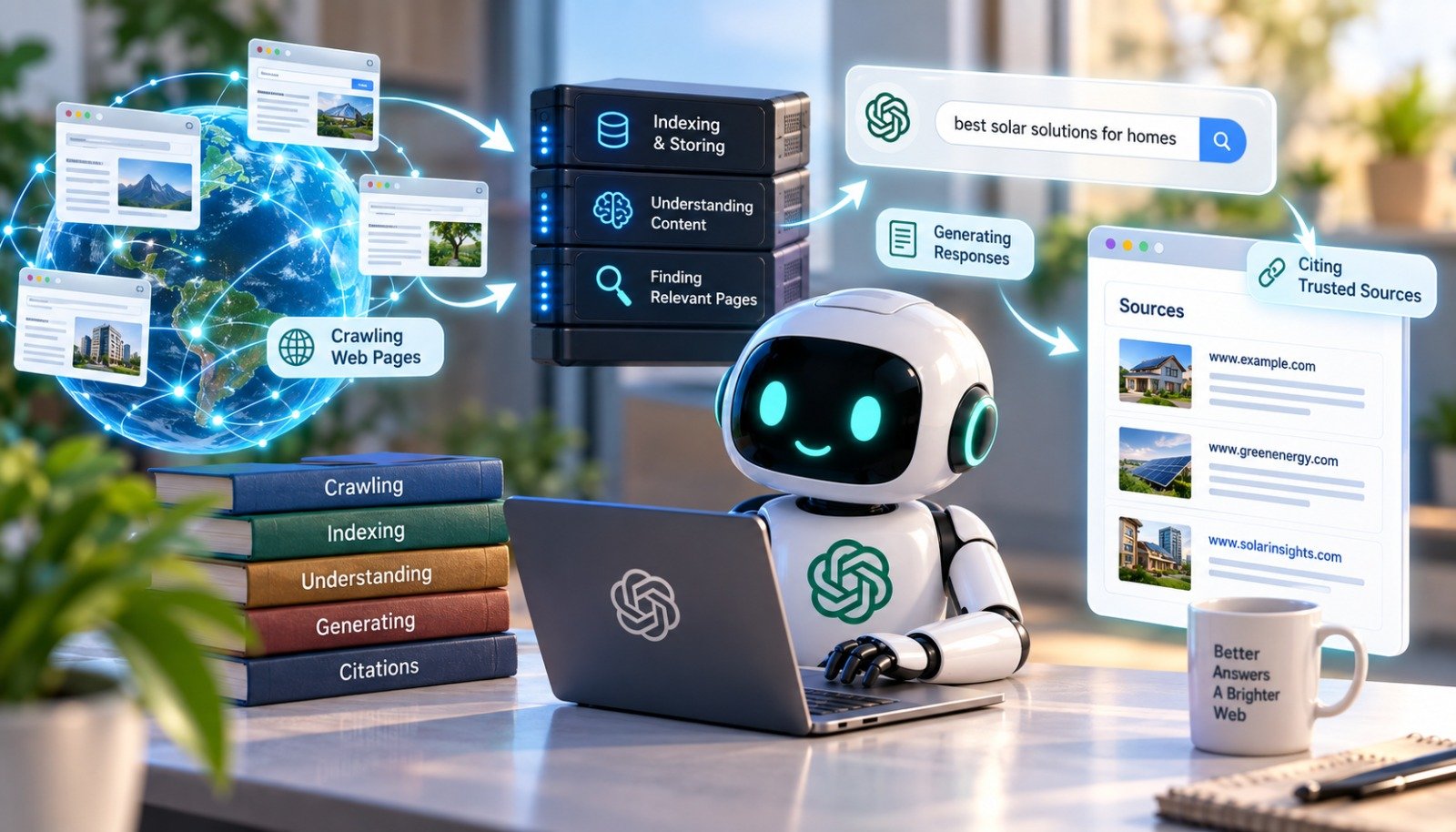
The process can involve several stages, including web discovery, crawling, search-query interpretation, information retrieval, relevance assessment and citation. Understanding these stages can also help businesses approach ChatGPT SEO, AI search optimization, and Generative Engine Optimisation (GEO) more effectively.
How Does ChatGPT Find Websites?
ChatGPT does not rely on a single source of information. When web search is available, ChatGPT can search the web and retrieve information relevant to a user’s question. OpenAI also operates different web crawlers for different purposes, including OAI-SearchBot, which is designed to help websites appear in ChatGPT’s search results.
This distinction is important because people often assume that ChatGPT simply knows everything that exists online.
It does not.
There is a difference between information that may have been included in an AI model’s training and information retrieved from the live web. When ChatGPT searches the web, it can retrieve current online information and use relevant sources to support its response.
In simple terms, ChatGPT can find websites through web-search and retrieval systems that identify information relevant to a user’s particular question.
ChatGPT Crawling and Google Crawling Are Not the Same
One of the biggest misconceptions about ChatGPT website crawling is that it works exactly like Google.
Google operates Googlebot and its own search infrastructure to discover, crawl, index and rank web pages. ChatGPT Search operates within OpenAI’s search and retrieval environment, with OAI-SearchBot specifically identified by OpenAI for search-related crawling.
That means ranking highly on Google does not automatically guarantee that ChatGPT will cite your website.
Google Search and ChatGPT Search may surface many of the same websites, but their discovery, retrieval, ranking and answer-generation processes are not identical.
For website owners, this means traditional SEO still matters, but AI search visibility requires thinking beyond conventional rankings.
What Happens When Someone Searches the Web Through ChatGPT?
When a person asks ChatGPT a question that requires current or specific information, the system can interpret the question and retrieve relevant web information.
Think of it as a journey from question to retrieval to answer.
The user’s wording provides context about what they are looking for. Search and retrieval systems then help identify potentially relevant information. ChatGPT can use those sources when constructing its response and may provide citations or links so users can investigate the information themselves.
This is particularly important for businesses because the objective is no longer simply getting a webpage onto a search results page.
The bigger opportunity is becoming a source that search and AI systems can easily discover, understand and use when answering relevant questions.
Why Does ChatGPT Cite Some Websites?
There is no public formula that guarantees a website will be cited by ChatGPT.
However, the fundamentals are relatively logical. If a webpage clearly answers the question being asked, contains useful information, demonstrates expertise and is accessible to search systems, it has the characteristics of a strong candidate for retrieval.
This is where EEAT Experience, Expertise, Authoritativeness and Trustworthiness becomes particularly valuable.
Consider two pages answering the same question. One provides a vague 500-word article filled with generic statements. The other provides clear explanations, original insights, evidence, relevant examples and information demonstrating genuine subject knowledge.
The second page gives users and retrieval systems more useful context, evidence and specificity with which to evaluate the information.
These qualities may improve the usefulness and credibility of a page, but they do not guarantee that ChatGPT will retrieve or cite it.. Rather, it provides a strong foundation for creating content that deserves visibility.
Can You Optimise Your Website to Appear in ChatGPT?
You cannot guarantee that ChatGPT will cite your website, but you can improve the quality and accessibility of the information you publish.
This starts with technical accessibility: important pages should be crawlable, clearly structured and available to the systems that may retrieve them.
Website owners should also check that OAI-SearchBot is not unintentionally blocked by robots.txt, hosting rules, firewalls or CDN settings if they want their content to be eligible for ChatGPT search discovery.
Content quality matters just as much.
Instead of writing articles purely around keywords, businesses should answer genuine customer questions with accurate, specific and useful information. Original research, first-hand experience, expert commentary, supporting evidence and clear explanations can make a page considerably more valuable. Where factual claims are important, link to authoritative primary sources wherever possible
This is where ChatGPT SEO and GEO overlap with established SEO principles.
At Site Invention, we think the more useful question is not “How do I make ChatGPT rank my website?” but rather “How do I make my website easy for search and AI systems to understand, trust and reference?”
SEO, GEO and LLM Visibility Are Connected
Traditional SEO focuses heavily on improving visibility within search engines. Generative Engine Optimisation (GEO) is a developing term for improving how content and brands are represented within AI-powered search and generative answer experiences.
LLM visibility takes the concept further by considering how brands and their expertise may be represented across large language model-powered experiences.
These disciplines should not be treated as completely separate from SEO.
A technically sound website with authoritative content, strong topical coverage, clear information architecture and genuine expertise provides a much stronger foundation for visibility across different search environments.
Google’s AI search experiences can also provide links to supporting websites, while ChatGPT can cite sources used in its responses. However, Google AI Overviews, Google AI Mode and ChatGPT Search are separate systems and should not be treated as if they use an identical ranking process.
Does Ranking on Google Guarantee ChatGPT Visibility?
No.
A website can rank well on Google without being cited by ChatGPT, just as a website appearing in an AI-generated answer should not be assumed to hold a permanent position.
AI search is dynamic. A citation can change depending on how the question is phrased, which sources are available, how current the information is and what context the conversation provides.
For businesses, this makes AI search visibility an ongoing content and SEO consideration rather than a one-time optimisation task.
Search Visibility Is Becoming Broader Than Rankings
Search is changing from a simple question of Where does my website rank? to a much broader question: Can search engines and AI systems discover, understand, trust and reference my expertise?
That shift is why businesses should not abandon traditional SEO in favour of every new AI optimisation trend. Instead, they should strengthen the fundamentals while making their content genuinely useful for modern search experiences.
A website that clearly demonstrates expertise, answers real questions, provides trustworthy information and remains technically accessible has a stronger opportunity to be discovered whether the user finds it through a conventional search result or an AI-generated answer.
Frequently Asked Questions
Q1. Does ChatGPT crawl websites?
Answer: Yes. OpenAI operates web crawlers for different purposes, and OAI-SearchBot is specifically associated with helping websites appear in ChatGPT search results.
Q2. Does ChatGPT use Google’s search index?
Answer: OpenAI does not publicly state that ChatGPT Search uses Google’s search index. OpenAI says ChatGPT Search uses third-party search providers and content from partners, while its OAI-SearchBot crawler helps discover web content that may appear in ChatGPT search.
Q3. How can I get my website cited by ChatGPT?
Answer: There is no guaranteed method. Publishing accurate, authoritative, original and clearly structured content while maintaining strong technical accessibility gives your website a better foundation for AI search visibility.
Q4. Is ChatGPT SEO different from Google SEO?
Answer: Yes, although there is considerable overlap. Technical SEO, crawlability, content quality and authority remain important, while AI search adds greater emphasis on how clearly information can be retrieved, interpreted and used within conversational answers.
Q5. What is GEO in SEO?
Answer: GEO stands for Generative Engine Optimisation. It refers to strategies intended to improve a brand’s visibility and representation within AI-powered search and generative answer experiences.
The Future of Search Visibility
As AI-powered search continues to grow, online visibility is no longer only about ranking highly on Google. Businesses also need websites that are technically accessible, clearly structured and filled with useful, trustworthy information that AI systems such as ChatGPT can understand and potentially reference.
At Site Invention, we help businesses strengthen their SEO and prepare for evolving AI search experiences through strong technical foundations, authoritative content and modern optimisation strategies. The focus is not simply on rankings, but on making your business easier to discover, understand and trust across traditional search engines and AI-powered platforms.
