
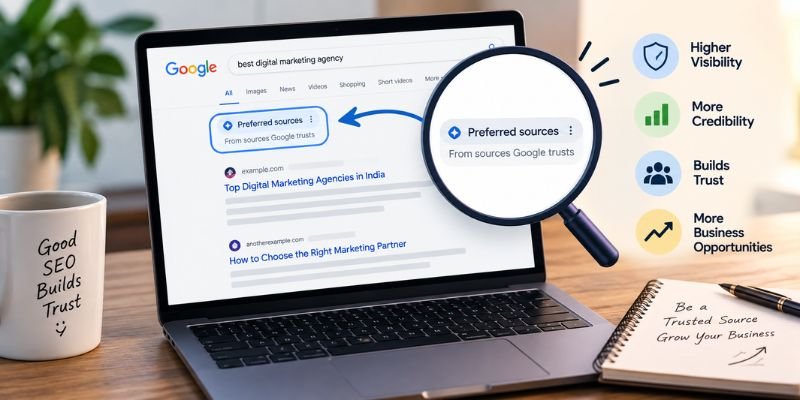
Google Search is changing. People are no longer relying only on traditional search results to find information; they are increasingly using AI Overviews and AI Mode to discover answers, brands and websites. As this shift continues, Google is giving users more control over the sources they want to hear from.
One feature gaining attention is Google’s Preferred Sources badge. For businesses, it raises an important question: could becoming a source that people actively choose influence how your brand is discovered in modern Google Search?
The answer is more nuanced than simply “yes”. The Preferred Sources feature is not a shortcut to higher rankings. Instead, it reflects a broader shift towards personalised search, trusted sources and AI-powered discovery.
What Is Google’s Preferred Sources Badge?
Google’s Preferred Sources feature allows users to select websites or publishers they trust and want to see more often. When a user chooses a website as a preferred source, Google can give relevant content from that source greater visibility in certain Search experiences.
The source can also be identified with a “preferred” badge in features such as AI Overviews and AI Mode. Google explains that preferred sources can also be more likely to appear in relevant Top Stories.
This is important because the feature is primarily about personalised search, rather than giving a website a permanent ranking advantage. In simple terms, Google is allowing users to tell Search, “This is a source I want to hear from.”
How Does Google Preferred Sources Work?

The process is relatively straightforward. A user finds a website or publisher they value and selects it as a preferred source. Google can then use that preference when determining which relevant content to surface in supported Search experiences.
This means the same website may receive preferred treatment for one user without receiving the same treatment for another person who has not selected it.
For businesses, this distinction matters. The objective should not be to chase a badge as though it were a conventional Google ranking signal. Instead, the bigger opportunity is to build a website that audiences recognise as useful, credible and worth returning to.
Is the Preferred Sources Badge a Google Ranking Factor?
Not in the traditional sense.
A preferred source selection does not mean that your website automatically moves higher in Google’s organic results for everyone. Google describes Preferred Sources as a personalisation feature, meaning its impact is connected to individual users and their selected sources.
Traditional SEO still matters. Search relevance, content quality, technical performance, website experience and other established signals continue to influence organic visibility.
The Preferred Sources feature adds another layer: user preference. This makes it particularly interesting for businesses thinking beyond conventional rankings and towards long-term brand visibility.
Why Should Businesses Care About Google Preferred Sources?
For a business owner, the biggest value is not necessarily the badge itself. It is what the feature represents about the future of search.
When someone actively chooses your website as a preferred source, that indicates a stronger level of recognition and trust than simply appearing for a one-off search query. The user is effectively saying that your website is a source they want Google to surface again.
That becomes even more relevant as Google expands AI-powered search. If people use AI Overviews and AI Mode to discover information, businesses need to think about how their content can become part of that discovery journey.
This is where SEO, brand authority and GEO (Generative Engine Optimisation) begin to overlap. Businesses are no longer competing only for clicks from traditional search results; they also need to establish why their content deserves to be considered by AI-powered search experiences.
What Does Google Preferred Sources Mean for SEO and GEO?

The rise of Preferred Sources does not mean that traditional SEO is disappearing. It means the definition of search visibility is becoming broader.
A strong GEO strategy should still be built on fundamentals that make content useful to both people and search systems. Original information, clear expertise, trustworthy authorship, accurate facts and genuinely helpful answers give a website a stronger foundation.
For example, a business publishing generic content simply to target keywords may struggle to become a source people actively trust. A business that shares original insights, practical experience and reliable information has a much stronger reason for users to return.
This is why AI search optimisation should not be treated as a separate replacement for SEO. Instead, it should build on a website’s existing authority, relevance and usefulness.
How Can a Business Become a Preferred Source?
There is no simple application form that guarantees a business will receive Preferred Source status. The feature is fundamentally driven by users selecting sources they want to follow.
That makes the strategy surprisingly human.
Businesses need to give people a reason to choose them. Consistently publishing valuable content, demonstrating genuine expertise, and creating a recognisable brand can encourage audiences to return. Clear authorship and transparent information can also strengthen trust.
Google has also introduced publisher functionality that can make it easier for eligible websites to let readers add them as preferred sources. However, the underlying principle remains the same: the audience chooses the source.
For a business investing in SEO, this reinforces an important lesson. Visibility should not be measured only by rankings. Becoming a trusted destination can be just as valuable.
Preferred Sources vs Traditional SEO
| Traditional SEO | Google Preferred Sources |
| Focuses heavily on search visibility | Focuses on user-selected sources |
| Works across Google’s broader organic Search system | Applies to users who choose preferred sources |
| Targets relevance to search queries | Adds a layer of personalisation |
| Rankings are a major performance indicator | Source recognition becomes important |
| Primarily focuses on discoverability | Encourages ongoing source preference |
The two approaches should not be viewed as competitors. Strong SEO can help people discover your website, while valuable content and brand trust can give them a reason to keep coming back.
From Search Visibility to Being a Source People Trust

Google’s Preferred Sources feature is a useful reminder that search is becoming more personalised and increasingly connected with AI. The real opportunity for businesses is not simply obtaining a “preferred” label. It is building a website that people recognise, trust, and deliberately choose.
For businesses investing in SEO and digital growth, that means focusing on more than rankings alone. Strong content, genuine expertise, technical SEO and a credible online presence can help create the kind of authority that matters across traditional and AI-powered search.
Site invention helps businesses build stronger digital foundations through SEO and website strategies designed around visibility, relevance, and long-term growth.
Frequently Asked Questions About Google Preferred Sources
Q1. What is Google’s Preferred Sources badge?
Answer: Google’s Preferred Sources badge identifies content from a source that a user has selected as preferred. Google can highlight that source in AI Overviews and AI Mode, while preferred sources can also receive additional visibility in relevant Top Stories.
Q2. Does becoming a preferred source improve Google rankings?
Answer: Not as a universal ranking boost. Preferred Sources is primarily a personalisation feature, so being selected by a user does not automatically move a website higher in Google’s organic results for everyone.
Q3. Can businesses encourage customers to choose them as a preferred source?
Answer: Yes. Businesses and publishers can make their audiences aware of the option to select their website as a preferred source. Google has also introduced publisher tools designed to make this process easier for eligible websites.
Q4. Does a Preferred Source guarantee visibility in AI overviews?
Answer: No. Being selected as a preferred source does not guarantee that every page will appear in an AI Overview or AI Mode response. Google still determines which information is relevant to a particular search.
