
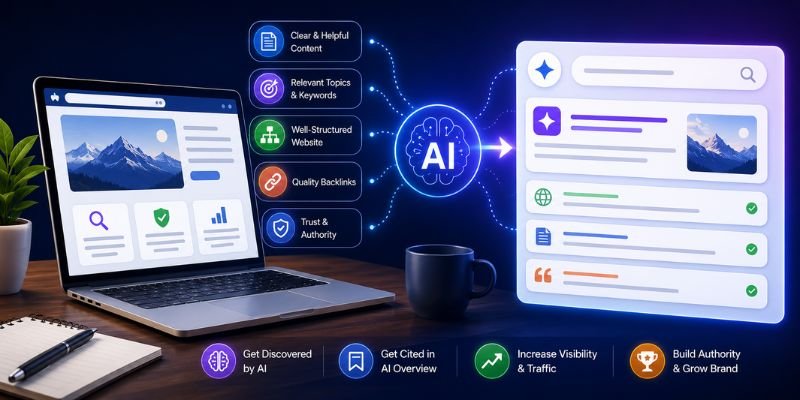
Building a successful website today involves much more than attractive visuals and smooth navigation. Effective web designing also needs to consider how AI-powered search understands, processes, and presents information to users. With Google AI Overviews and generative search changing the way people find answers online, businesses need websites with clear content, logical structures, and useful information that is easy to understand and discover.
A website design company in Mumbai building websites today means thinking beyond visual appearance. Modern websites should clearly communicate what a business does, who it serves, and why its information is useful. With AI search experiences such as Google AI Overviews, ChatGPT Search, and Bing Copilot becoming part of the evolving search landscape, businesses need websites that are easy for both people and search systems to discover, understand, and navigate.
What Is Web Design for AI Search?
AI-search-friendly web design combines Web Designing, SEO, website architecture, content structure, usability, and machine understanding. The objective is not to design a website specifically for an AI system, but to create a clear digital environment where important information is easy to discover, interpret, and connect.
A well-organized website gives each page a clear purpose. Navigation, headings, internal links, URLs, structured data, and useful copy work together to establish relationships between topics and entities.
This is closely connected to semantic SEO. When a page clearly explains a subject and provides relevant context, it becomes easier for search systems to understand what the page represents.
Why AI Overviews Matter for Your Website
Google AI Overviews and other generative search experiences can change how users interact with search results. AI systems may combine information from multiple sources when generating an answer, meaning users may encounter a business without necessarily following the traditional path of clicking a blue link first.
This does not mean every website will receive an AI Overview citation. There is no guaranteed method for securing one. However, businesses can improve the clarity and usefulness of their online information.
Websites should provide direct answers, accurate business information, supporting context, and genuinely helpful content rather than writing solely for keywords.
The rise of zero-click search also makes brand visibility important. A website that consistently demonstrates expertise and provides useful information can create stronger opportunities to be understood across different search experiences.
How AI Search Understands Website Content
Clear Website Architecture
Website architecture determines how information is organized and connected. A visitor should be able to move naturally from a main service page to relevant supporting pages without confusion.
Clear navigation and descriptive URLs help establish page relationships. Internal linking can also connect related services, blog articles, FAQs, and informational resources.
A strong architecture commonly includes:
- Clear navigation menus
- Logical page hierarchy
- Descriptive URLs
- Relevant internal links
- Dedicated service and information pages
These practices support both content discoverability and conventional SEO.
Semantic and Structured Content
AI systems need context. A page with one large block of text is harder to interpret than a page organized with meaningful sections.
Using H1, H2, and H3 headings creates a logical information hierarchy. Semantic HTML further communicates what different elements represent, while schema markup can provide additional machine-readable context about eligible entities and content.
Definitions, supporting explanations, FAQs, and contextual references can make a page more comprehensive without making it unnecessarily long.
Structured data should be accurate and relevant to the visible content. It is a supporting technical layer—not a shortcut to AI visibility.
Helpful and Authoritative Content
Good AI-search optimization starts with good information.
Content should address search intent rather than repeatedly inserting a target keyword. Businesses can strengthen topical authority by publishing original insights, demonstrating first-hand experience, citing reliable information where appropriate, and keeping important pages accurate.
This aligns with Google’s broader emphasis on helpful, reliable content and concepts associated with E-E-A-T: experience, expertise, authoritativeness, and trustworthiness.
Technical SEO Still Matters
AI-friendly content cannot compensate for a website that search engines struggle to access or users struggle to use. Technical website quality remains an important foundation.
Crawlability allows search systems to discover pages, while indexability determines whether eligible pages can be stored and surfaced. Mobile responsiveness ensures the website works across devices, and page speed supports a better user experience.
Core Web Vitals, HTTPS, accessibility, clean HTML, XML sitemaps, canonical URLs, and sensible internal linking should therefore remain part of a professional web development process.
For business owners, the principle is simple: make the website technically accessible, fast, understandable, and easy to navigate.
Website Elements That Support AI Search
| Website Element | Why It Matters |
| Website Architecture | Helps establish relationships between pages and topics |
| Semantic HTML | Makes content structure clearer to machines |
| Structured Data | Adds machine-readable context where applicable |
| Internal Linking | Connects related information and supports discovery |
| Mobile Responsiveness | Improves usability across devices |
| Page Speed | Supports performance and user experience |
| Clear Content | Makes important information easier to interpret |
Common Web Design Mistakes That Can Hurt AI Search Visibility

Several website problems can make information less useful or harder to discover:
- Poor website structure and confusing navigation
- Thin or generic content
- Keyword stuffing and repetitive copy
- Slow-loading or poorly optimized pages
- Weak mobile experience
- Unclear business information
- Weak internal linking
- Poorly structured content
These problems often affect more than search visibility. They can reduce trust, increase friction, and make it harder for potential customers to understand a company’s services.
For example, a service page filled with generic marketing phrases may look polished but provide little useful information. A stronger page explains the service, its purpose, process, benefits, limitations, and relevant questions in natural language.
Making Content Easier for AI Search to Understand
Businesses should think about information clarity before thinking about keyword density. Each important page should answer the questions a real customer is likely to ask.
Clear service descriptions, location information, company details, relevant FAQs, supporting articles, and consistent terminology can help establish context.
Entity optimization is also becoming more relevant. A company should clearly identify its name, services, location, areas served, and relationships between its website pages. This gives search systems more consistent information to work with.
How Site Invention Helps Businesses Build AI-Ready Websites
Site Invention is a Mumbai-based web design and web development company focused on creating professional digital experiences for businesses. Its approach can combine modern Web Designing with responsive development, user experience, website performance, and SEO-friendly architecture.
An AI-ready website should not be treated as a separate type of website. Instead, it should be built on strong fundamentals: logical navigation, responsive design, clean development, structured content, fast-loading pages, and a technically sound foundation.
For businesses in Mumbai, Site Invention can help address areas such as responsive website development, technical SEO foundations, mobile-friendly design, performance, structured content, and website usability while keeping business objectives at the center of the project.
The goal is to create a website that communicates clearly with its customers and provides a strong technical foundation for search discovery.
Building Websites for the Future of Search
Modern Web Designing needs to serve three audiences: human visitors, traditional search engines, and AI-powered search experiences.
There is no guaranteed way to earn a citation in Google AI Overviews or another generative search system. However, businesses can make their websites easier to understand by combining useful content, logical website architecture, technical SEO, semantic structure, strong user experience, and trustworthy information.
A website built on these fundamentals is better positioned to remain useful as search continues to evolve.
Frequently Asked Questions
Q1. What is AI-search-friendly web design?
Answer: AI-search-friendly web design uses clear navigation, structured content, and accessible information to help both users and search systems understand a website.
Q2. Can web design affect visibility in Google AI Overviews?
Answer: Yes. Clear structure, useful content, internal linking, mobile responsiveness, and technical SEO can support better content discovery, although AI Overview citations cannot be guaranteed.
Q3. Does schema markup help with AI search?
Answer: Schema markup helps search engines understand certain content and entities. It can support search visibility but does not guarantee rankings or AI Overview citations.
Q4. How can I make my website easier for AI search engines to understand?
Answer: Use clear headings, logical navigation, descriptive URLs, internal links, natural language, structured data, and technically accessible, mobile-friendly pages.
Q5. Can a Website Design Company in Mumbai optimize a website for AI search?
Answer: Yes. A Website Design Company in Mumbai can improve website structure, performance, technical SEO, responsive design, and content organization to create a stronger foundation for AI search.
