
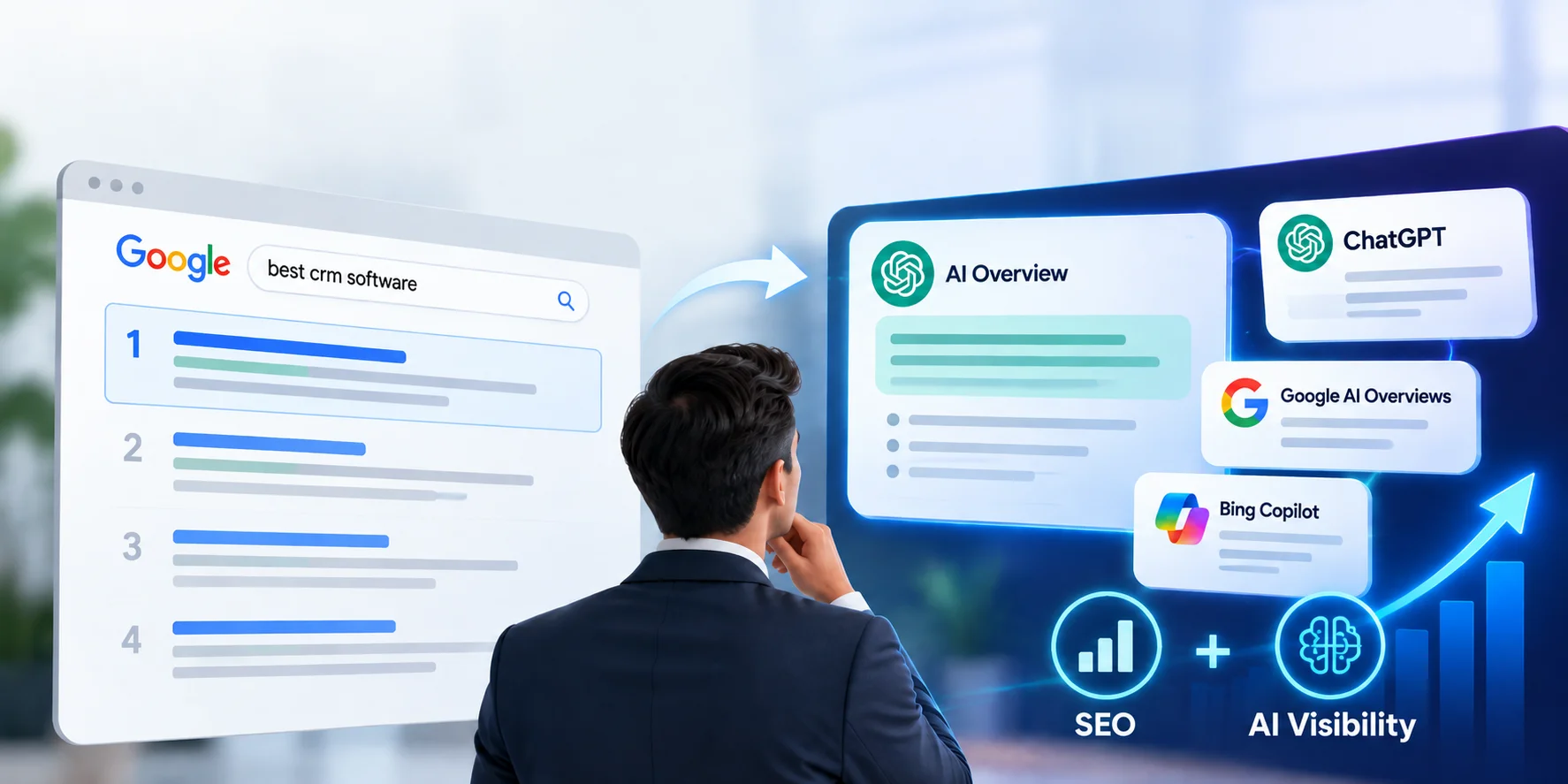
For years, search visibility was relatively easy to understand: identify the keywords your customers search for, improve your Google rankings, and earn more organic traffic.
That model still matters. But it no longer tells the whole story.
Search results have evolved from a list of blue links into a much broader discovery environment. Featured snippets, rich results, AI Overviews, AI Mode and conversational AI tools can now influence how people research a problem, compare solutions and discover businesses.
This changes an important question for businesses.
Instead of asking only, “Where do we rank for this keyword?”, you also need to ask, “Where does our brand appear when customers are researching this topic?”
That is where SEO and AI visibility increasingly intersect.
What Does “Being Visible in Search” Mean Today?
Search visibility used to be closely connected to positions on a search engine results page (SERP). Higher rankings generally meant greater opportunities to earn clicks.
Today’s search journey can look very different.
A potential customer might:
Ask a question → read an AI-generated response → ask a follow-up → compare several options → research a brand → visit a website
The traditional search result is still part of this journey, but it may no longer be the only—or first—interaction.
Google itself now treats search appearance as broader than standard organic listings, encompassing AI features, featured snippets, images, videos and other search experiences.
For businesses, that creates two connected dimensions of visibility:
| Visibility | What it tells you |
| Traditional SEO visibility | Whether your pages can be discovered and rank for relevant searches |
| AI search visibility | Whether your content or brand can surface within AI-assisted discovery experiences |
| Business visibility | Whether that exposure ultimately contributes to awareness, qualified visits, enquiries and conversions |
The goal isn’t to abandon rankings. It is to understand the fuller search journey surrounding them.
Are Keyword Rankings Still Important?

Absolutely.
Keywords reveal how people search, and rankings remain an important indicator of organic search performance. Google has also made clear that established SEO best practices remain foundational to its generative AI search features.
The problem is using keyword positions as the only measure of SEO success.
A business could rank well for several important terms while having limited visibility when potential customers ask AI systems detailed questions about problems, providers, alternatives or comparisons.
Searches are also becoming more specific and conversational. Instead of entering a broad keyword, someone might ask:
- What should I consider when choosing a solution for my business?
- Which option would be suitable for my requirements and budget?
- What are the differences between these solutions?
These searches may concern the same broad topic, but they reveal much more context and intent.
Modern search visibility therefore requires understanding keywords, search intent, entities, topics and conversational queries together.
Why Is Ranking on Google No Longer the Whole Picture?
People don’t always search using short keyword phrases anymore.
AI-assisted search makes it easier to ask complex questions and continue the conversation. Google’s AI Mode, for example, is designed for nuanced questions, exploration and comparisons that might previously have required multiple separate searches.
That means the customer journey can begin before someone reaches your website.
Imagine a business buyer researching cybersecurity providers. Instead of opening ten websites immediately, they might first ask:
“What should a mid-sized financial company consider when choosing a cybersecurity provider?”
Then:
“Compare the main approaches.”
And eventually:
“Which providers specialise in these requirements?”
A business that provides clear, credible information around these connected topics has more opportunities to become part of that research journey than one publishing isolated pages around individual high-volume keywords.
This is one reason topical authority matters.
Rather than creating dozens of pages simply to capture keyword variations, businesses should demonstrate genuine depth around the subjects in which they claim expertise—covering important concepts, customer questions, problems, comparisons and decision-stage information.
Google’s current guidance similarly emphasizes original, useful, non-commodity content rather than producing separate pages for every possible query variation.
If AI Answers the Question, Will Businesses Lose Website Traffic?
For some types of searches, AI-generated answers can reduce the need for an immediate click.
Research from Pew found that in its March 2025 sample of U.S. adults, users clicked a traditional search result on 8% of visits when an AI summary appeared, compared with 15% when one did not. Only 1% of visits with an AI summary resulted in a click on a cited source within the summary.
More recent Ahrefs research using Search Console data from more than 400,000 websites estimated that the presence of AI Overviews was associated with substantially lower click-through rates for top organic results.
That doesn’t mean businesses should conclude that “SEO traffic is disappearing.”
It means impressions, rankings and traffic need more context.
The more useful questions are:
- Which queries are losing clicks?
- Is the brand still being surfaced during the research journey?
- Which searches continue to generate qualified visits?
- What do those visitors do after reaching the website?
- Are organic enquiries, conversions and revenue changing alongside traffic?
A decline in clicks and a decline in business performance are not automatically the same thing.
What Happens If Your Competitors Appear in AI Answers and You Don’t?
This is where AI visibility becomes commercially important.
Potential customers use search and AI tools to understand problems, create shortlists, compare products and evaluate providers. If competitors consistently appear during those moments while your business is absent, they may gain an earlier opportunity to build familiarity.
Think of it as visibility before the click.
A prospect may encounter a company while asking:
- What solutions are available?
- What is the difference between option A and option B?
- What does this service typically cost?
- What should I consider before choosing a provider?
- Which solution is appropriate for my particular situation?
This makes Answer Engine Optimisation (AEO) and Generative Engine Optimisation (GEO) useful ways of thinking about certain search experiences. But they shouldn’t become excuses for chasing AI “hacks.” Google explicitly says that, for its generative search features, strong SEO fundamentals remain relevant and warns against tactics created solely to manipulate AI visibility.
The opportunity is broader: become a genuinely useful and credible source within the topics your customers research.
How Does Topical Authority Support SEO and AI Visibility?
Topical authority isn’t about mentioning the same keyword across dozens of articles.
It comes from building a connected body of useful information that demonstrates depth around the subjects most relevant to your business and customers.
Instead of publishing only a primary service or product page and targeting its main keyword, a business can build supporting content around areas such as:
- common customer problems and questions;
- different approaches and available solutions;
- costs and other decision factors;
- comparisons and alternatives;
- risks and common mistakes;
- industry developments and insights;
- practical guidance for different stages of the buying journey.
Strong internal linking then helps connect those resources to relevant commercial pages.
This creates context for both people and search systems: what the business knows, what problems it solves, and which subjects it has genuine expertise in.
This is also where Site Invention’s AI SEO approach can help. Instead of treating AI visibility as a standalone tactic, Site Invention can assess content gaps, search intent, technical SEO, topical coverage and entity relationships to build a more connected search strategy.
How Can AI Visibility Benefit a Business?
AI visibility shouldn’t be measured simply by collecting screenshots of brand mentions.
Its potential business value lies in where those mentions occur in the customer journey.
A useful way to think about it is:
Relevant visibility → brand discovery → familiarity → consideration → qualified website visit → enquiry or conversion
For businesses with longer buying cycles, that first discovery can matter even when it doesn’t immediately generate a click.
AI visibility can potentially help a business:
- appear across more research and discovery moments;
- build awareness around relevant topics;
- reach people asking detailed, high-intent questions;
- strengthen association between the brand and its area of expertise;
- create additional paths toward its website and commercial pages.
But visibility itself is not the final KPI. Qualified demand and business outcomes are.
Do Businesses Need AI SEO Instead of Traditional SEO?
No. The more useful model is SEO + AI visibility, not SEO versus AI SEO.
For Google specifically, pages generally still need the fundamentals: crawlability, indexability, useful content, internal links, technical accessibility and a strong page experience. There is no special AI schema or secret markup required to appear in Google’s AI features.
Traditional SEO therefore remains the foundation.
For businesses looking to bridge traditional search optimization with emerging AI discovery, AI SEO services can help build a strategy that supports visibility across both search engines and AI-driven experiences.
What expands is the scope of the strategy:
Keywords → search intent → topics → entities → customer questions → authoritative content → AI-assisted discovery
For businesses unsure where the gaps are, Site Invention can evaluate both the traditional SEO foundation and the wider search environment—from technical accessibility and content architecture to topical authority and emerging AI visibility opportunities.
What Should Businesses Measure Beyond Keyword Rankings?
As search changes, SEO reporting needs to evolve with it.
Instead of relying on a single metric, businesses should look at a combination of indicators:
| Measure | Business question it answers |
| Keyword rankings | Are we competitive in traditional organic search? |
| Search impressions | How often are we being surfaced? |
| Organic traffic | How many visits is search generating? |
| AI visibility/mentions | Are we appearing in relevant AI-assisted discovery? |
| Branded searches | Is awareness of our brand changing? |
| Conversions & leads | Is search contributing to actual business opportunities? |
Measurement is improving too. In 2026, Google introduced dedicated Generative AI performance reporting in Search Console, including visibility data for generative AI features.
The broader lesson is simple: don’t let one ranking report define the success of an entire search strategy.
So, What Should Businesses Do Next?
Businesses don’t need to throw away their SEO strategy and start again.
They need to broaden it.
Start by:
- maintaining strong technical and on-page SEO;
- understanding the questions customers ask throughout the buying journey;
- building meaningful topical authority instead of producing isolated keyword articles;
- creating original, expert-led content that adds something competitors don’t;
- connecting informational content with relevant commercial pages;
- making important business, product and service information clear and accessible;
- monitoring AI-assisted visibility alongside rankings, traffic and conversions.
Most importantly, create content for the customer’s complete decision journey, not simply for a keyword.
Search Visibility Has Expanded—Your Strategy Should Too
Keyword rankings aren’t obsolete. They remain an important part of understanding organic search performance.
But customers now discover, research and evaluate businesses across a wider search landscape. The winning objective is therefore no longer simply “rank for more keywords.”
It is to build a search presence that makes your business discoverable, understandable and credible wherever relevant customers are researching their next decision.
That requires SEO fundamentals, useful content, topical authority, strong information architecture and an informed approach to AEO, GEO and AI-assisted discovery.
Site Invention can help businesses connect those pieces—identifying SEO and content gaps, strengthening topical and technical foundations, and developing a strategy designed for visibility across both traditional and AI-assisted search.
Because the metric that ultimately matters isn’t how many keywords you track.
It’s whether the right customers can find—and choose—your business.
FAQs
1. What is AI visibility in SEO?
Answer: AI visibility refers to how often and how prominently a brand, website, or its content appears in AI-generated search results and answers. This can include citations, mentions, recommendations, and referenced content across AI-powered search experiences.
2. Is AI SEO replacing traditional SEO?
Answer: No. AI SEO complements traditional SEO rather than replacing it. Technical SEO, crawlability, quality content, authority, internal linking, and search intent remain important foundations for both organic rankings and AI search visibility.
3. How can I make my website more visible in AI search results?
Answer: Focus on creating original, useful content that answers relevant customer questions clearly and demonstrates expertise across your core topics. Strong technical SEO, topical authority, structured information, internal linking, and clear brand signals can also support AI discoverability.
4. What is the difference between SEO, AEO, and GEO?
Answer: SEO focuses broadly on organic search visibility, while AEO (Answer Engine Optimization) focuses on making content useful for direct-answer experiences. GEO (Generative Engine Optimization) focuses on improving visibility within generative AI-powered search and answer environments.
5. Do keyword rankings still matter with AI search?
Answer: Yes. Keyword rankings remain an important SEO metric, but they no longer represent the complete search journey. Businesses should consider rankings alongside impressions, clicks, conversions, AI mentions, citations, branded searches, and other indicators of search visibility.
6. Can AI search affect website traffic and clicks?
Answer: Yes. AI-generated answers can sometimes satisfy informational searches without an immediate website visit, which may affect click-through rates. However, AI search can also introduce brands during research and consideration, making the quality and business value of traffic increasingly important alongside traffic volume.
7. How do you measure AI search visibility?
Answer: AI visibility can be monitored through brand mentions and citations in relevant AI responses, referral traffic from AI platforms, branded search trends, search performance, and conversions. Because measurement methods are still developing, businesses should evaluate AI visibility alongside traditional SEO and commercial KPIs.
